
7 oct 2026 · @Marc Cirio
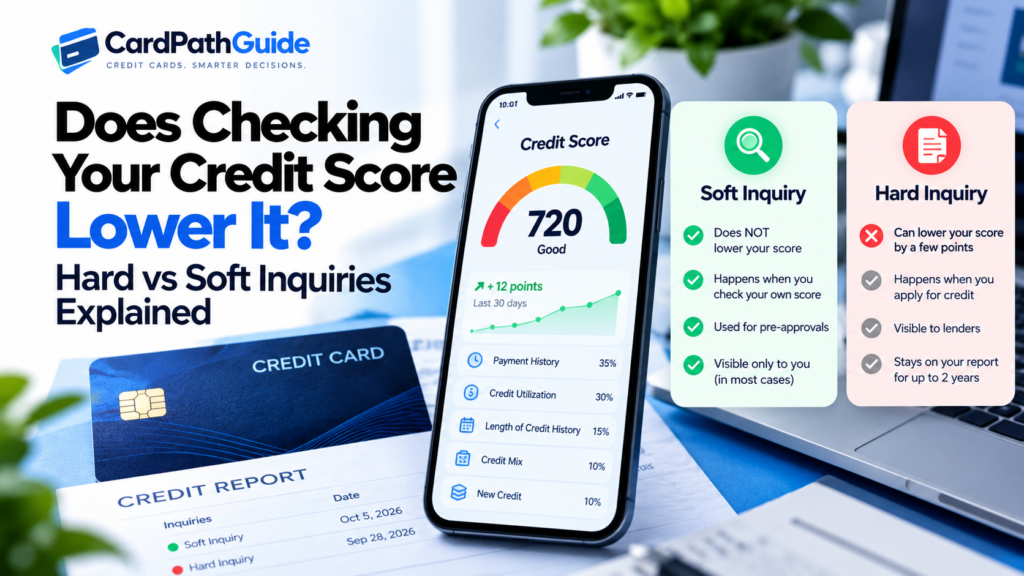
Does Checking Your Credit Score Lower It? No, checking your own credit score or credit report does not lower your score. It is called a soft inquiry, and it is only visible to you. What can lower your score slightly is a hard inquiry, which happens when you apply for credit and a lender checks your report to make a decision. The effect of one hard inquiry is usually small and temporary.
This distinction matters because many people avoid looking at their credit for fear of hurting it. In fact, checking regularly is one of the best habits you can have: it helps you catch errors, spot fraud and see the effect of your progress. In this guide you will see the difference between soft and hard inquiries, how much a hard inquiry really costs, how long it lasts and how to protect your score when you apply for credit.
Inquiries are part of the “new credit” factor, which is about 10% of a FICO Score. To see how the other factors work together, read How Is Your Credit Score Calculated? The 5 Factors Explained.
Last updated: October 2026.
Soft inquiries vs hard inquiries
| Soft inquiry | Hard inquiry | |
|---|---|---|
| What it is | A check of your credit that is not connected to a credit application | A check of your credit by a lender because you applied for credit |
| Affects your score? | No | Can lower it slightly and temporarily |
| Do lenders see it? | No, only you see it on your report | Yes, other lenders can see it |
| Needs your permission? | Not always | Yes, you must authorize it |
| How long it stays on your report | Visible only to you; it does not count toward your score | 2 years |
Examples of soft inquiries
- Checking your own credit score or credit report.
- Pre-qualification or pre-approval offers, when the lender only checks to see if you may qualify.
- A lender or card issuer reviewing your existing account.
- An employer doing a background check, with your permission (they do not see your score).
- Insurance companies checking your report to give a quote, in most cases.
- Credit offers you receive in the mail.
Examples of hard inquiries
- Applying for a credit card.
- Applying for a mortgage, auto loan, personal loan or student loan.
- Asking for a credit limit increase, in some cases.
- Applying to rent an apartment, if the landlord checks your credit through a hard inquiry.
- Opening some utility, internet or phone accounts that review your credit.
When you are not sure, you can ask the company before you apply whether it will make a hard or a soft inquiry.
How much does a hard inquiry lower your score?
For most people, one hard inquiry lowers a score by a few points at most, and the effect fades over time. It can matter more in some situations:
- If you have a short credit history, because there is less other information to balance it.
- If you have several inquiries in a short time, because that can suggest you are looking for a lot of credit at once.
- If your score is close to a lender’s cutoff, where a few points can change the result of an application.
Hard inquiries are not a major factor compared with the habits that matter most, which are paying on time and keeping your balances low. If you want to understand where to focus first, read How to Raise Your Credit Score 100 Points: What Actually Works.
How long do hard inquiries stay on your report?
| Where | How long |
|---|---|
| On your credit report | 2 years |
| In FICO Scores | Only inquiries from the last 12 months are counted |
| Impact on your score | Largest at first, and it fades as months go by |
That means that after a year, a hard inquiry usually stops affecting a FICO Score, even though it is still visible on your report for another year.
Rate shopping: why several inquiries can count as one
If you shop around for a mortgage, auto loan or student loan, you do not have to worry about each lender’s check. Scoring models generally treat multiple inquiries of the same type made within a short window as a single inquiry. The window is typically between 14 and 45 days, depending on the scoring model, so it is best to do all your comparisons within a couple of weeks.
Two important limits:
- This does not apply to credit cards. Each credit card application is counted as a separate hard inquiry.
- Different loan types do not combine. An auto loan inquiry and a credit card inquiry are counted separately.
Rate shopping is encouraged, so do not hesitate to compare offers. Just keep the applications close together.
How to check your credit score safely
You can check your own credit as often as you like without any effect. These are the most common free options:
- Your bank or credit card issuer. Many include a free FICO or VantageScore in your online account or app.
- AnnualCreditReport.com. This is the official source for free credit reports from Equifax, Experian and TransUnion. Reports do not include a score, but they show every account and inquiry that the score is based on.
- Free credit score services. Some show a score and the main factors behind it. Compare the model they use before you treat the number as exact.
A few precautions:
- Use the official site for reports. Type the address of AnnualCreditReport.com yourself instead of clicking on an ad, since there are many look-alike sites.
- Be careful with “free trials.” If a service asks for a card number for a free score or report, read the terms. You can get the essentials for free elsewhere.
- Do not share your credit information through email or text messages that you did not start.
To understand what your number means, see What Is a Good Credit Score? Ranges by Model (FICO and VantageScore).
How often should you check?
- Your score: monthly is a good habit, since it lets you see how your balances and payments affect it.
- Your credit reports: at least once a year, and before you apply for a major loan, to catch errors early.
How to reduce hard inquiries
You cannot avoid every hard inquiry, but you can avoid unnecessary ones:
- Check pre-qualification first. Many card issuers and lenders let you see whether you are likely to be approved with a soft inquiry before you submit a full application.
- Apply only when you need the credit. Each credit card application is a separate hard inquiry.
- Space out card applications. Applying for several cards close together can lower your score and make lenders cautious. Some issuers also have their own limits on how many new cards they approve.
- Group loan applications. When you shop for a mortgage, auto loan or student loan, do it within a short window, so the inquiries are counted as one.
- Know your starting point. If you are building credit from nothing, start with one product. The plan in How to Build Credit From Scratch: A 6-Month Plan shows how.
Can you remove a hard inquiry?
Accurate hard inquiries cannot be removed early. They drop off your report after two years, and they stop counting in FICO Scores after 12 months.
If you find an inquiry that you did not authorize, you can dispute it with the credit bureau that shows it. Unauthorized inquiries can be a sign of identity theft, so also check your reports for accounts you do not recognize and consider placing a fraud alert or a credit freeze.
Also keep in mind that other things can lower a score by a lot more than an inquiry, such as high balances. To see how that works, read What Is Credit Utilization and Which Ratio Is Best?.
Frequently asked questions
No. Checking your own score or report is a soft inquiry and never affects your score, no matter how often you do it.
No. Those are soft inquiries. Only when you apply for credit does a lender make a hard inquiry.
For most people it is a few points at most, and the effect fades over time. It can matter more if you have a short history or several inquiries close together.
Two years. FICO Scores only count inquiries from the last 12 months.
Do pre-qualification offers affect my score? Usually not. Pre-qualification generally uses a soft inquiry. A full application that follows may use a hard inquiry, so check before you submit it.
Do multiple credit card applications count as one inquiry? No. Rate shopping rules apply to mortgages, auto loans and student loans. Each credit card application is counted separately.
Does a credit freeze affect my score? No. A freeze does not change your score. It only prevents most lenders from opening new accounts using your information, and you can temporarily lift it when you apply for credit.
Will an inquiry stop me from getting approved? A single inquiry rarely makes the difference. Lenders look at your whole credit profile, including payment history, balances and income.
How long does it take to recover from a hard inquiry? The effect fades over a few months and normally stops counting in FICO Scores after a year. For wider timelines, see How Long Does It Take to Build Credit? Realistic Timelines.
Disclaimer
This article is for educational purposes only and is not financial, legal or credit advice. Scoring models and lender practices vary and change over time, and the effect of an inquiry depends on your individual credit profile. Check current information with the scoring companies or your lender before making a decision.
Sources
- myFICO (myfico.com): how inquiries and new credit affect a FICO Score and rate shopping.
- VantageScore (vantagescore.com): how inquiries are treated in VantageScore models.
- Consumer Financial Protection Bureau (consumerfinance.gov): credit reports, inquiries and credit freezes.
- Federal Trade Commission (consumer.ftc.gov): fraud alerts, credit freezes and identity theft.
- AnnualCreditReport.com: the official source for free credit reports.
Related reading: How Balance Transfer Cards Work: Fees, Intro APRs and Pitfalls and Credit Cards for Fair Credit: What to Look For and What to Avoid.