
7 oct 2026 · @Marc Cirio
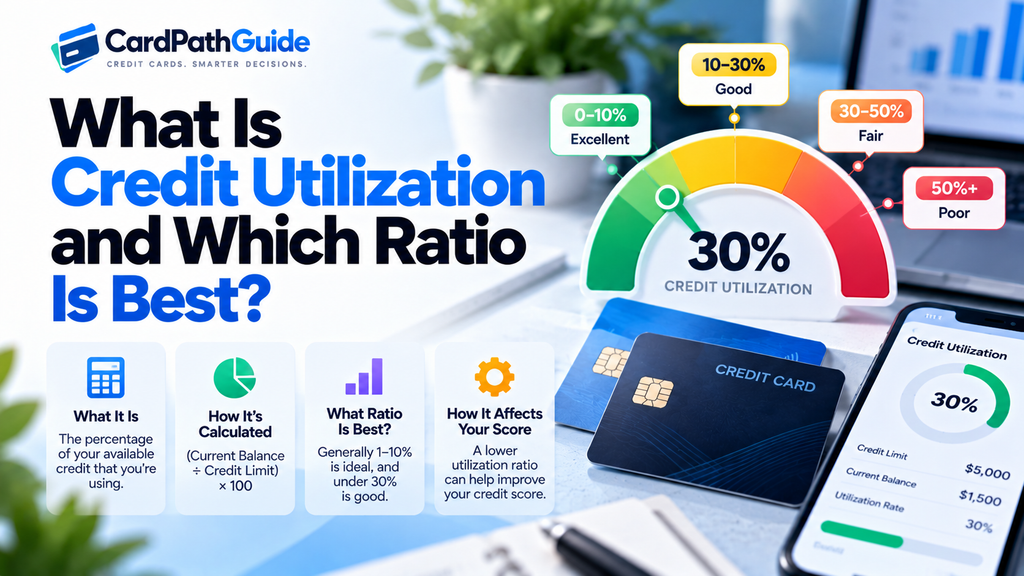
Credit utilization is the percentage of your available revolving credit that you are using. It is calculated by dividing your credit card balances by your credit limits. A common guideline is to keep it below 30%, and a lower ratio, such as under 10%, is generally better for your score. Utilization is part of the «amounts owed» category, which makes up about 30% of a FICO Score, so it is one of the most influential and most controllable factors.
Unlike many other parts of your credit, utilization has little memory in most scoring models. It reflects the balances your lenders report now, so it can improve quickly when you pay down your cards. This guide explains how utilization is calculated, what ratio to aim for, when your balance is actually reported and how to lower it.
Last updated: October 2026.
How to calculate your credit utilization
The formula is simple:
Utilization = total balances ÷ total credit limits × 100
Scoring models look at it in two ways: per card (each card on its own) and overall (all your revolving accounts combined). Both matter. Here is an example:
| Card | Balance | Credit limit | Utilization |
|---|---|---|---|
| Card A | $900 | $1,000 | 90% |
| Card B | $100 | $4,000 | 3% |
| Card C | $0 | $5,000 | 0% |
| Overall | $1,000 | $10,000 | 10% |
Your overall ratio is only 10%, which looks excellent. But Card A is almost at its limit, and a card close to its limit can hurt your score even if your overall ratio is low. That is why it is better to spread your balances than to concentrate them on one card.
What counts and what does not
- Counts: credit cards and other revolving accounts, such as lines of credit.
- Does not count in the same way: installment loans, such as car loans, student loans and mortgages. They are part of «amounts owed», but they do not have a utilization ratio like a credit card does.
- Closed cards: a closed card no longer counts as available credit, which can raise your overall ratio.
- Cards with no preset limit: the way they are treated varies between models and issuers.
Which credit utilization ratio is best?
There is no official cutoff, but the general pattern is clear: the lower, the better. This table is a guide to how different ranges tend to affect a score, not a rule from any scoring company.
| Utilization | General effect on your score |
|---|---|
| 0% to 9% | Very positive; typical of people with the highest scores |
| 10% to 29% | Positive; within the common guideline |
| 30% to 49% | Neutral to negative; the score starts to feel the pressure |
| 50% to 74% | Negative |
| 75% or more | Very negative; close to the limit signals risk |
Two important points:
- 30% is a guideline and not a magic number. Going from 31% to 29% does not suddenly change your score. The effect builds gradually as the ratio rises.
- 0% is fine. You do not need to carry a balance. If your cards report a zero balance, you are not penalized for it. Some people find that a very small reported balance, in the low single digits, is slightly better than all cards reporting zero, but the difference is small, and it is never worth paying interest to achieve it.
When is your balance reported?
This is the detail that surprises most people. Card issuers generally report your balance to the credit bureaus once a month, usually on your statement closing date, and not on your payment due date. The due date is typically about three weeks later.
Here is what that means. Suppose your card has a $1,000 limit:
| What you do | Balance reported | Utilization reported |
|---|---|---|
| Spend $600 during the month and pay it in full on the due date, after the statement closes | $600 | 60% |
| Spend $600 but pay $500 before the statement closes, then pay the rest on the due date | $100 | 10% |
In both cases you paid in full and paid no interest, but the second case reports a much lower balance. If you use your cards a lot and want a low utilization on your report, pay down the balance a few days before the statement closing date. You can find that date on your statement or in your card app.
Some newer scoring models, such as VantageScore 4.0 and FICO 10 T, also look at trends in your balances over time. In those models, a consistent pattern of low balances helps, and a pattern of high balances may count against you even if you pay them off.
How to lower your credit utilization
There are two ways to improve the ratio: reduce the balance (the top of the fraction) or increase the limit (the bottom of the fraction). These are the most common approaches:
- Pay down your balances. This is the most direct method. If you cannot pay everything, start with the card that has the highest utilization, and keep an eye on the interest rate too, since paying down the card with the highest interest rate saves you the most money.
- Pay before the statement closing date. As explained above, a payment made before your statement closes means a lower balance is reported.
- Make several smaller payments during the month, especially if you put most of your spending on one card.
- Ask for a credit limit increase. If your issuer agrees, the same balance on a higher limit gives a lower ratio. Ask whether the request uses a soft inquiry, since a hard inquiry can lower your score slightly and temporarily. Increasing your limit only helps if you do not spend more.
- Spread your spending across cards, so that no single card is close to its limit.
- Keep paid-off cards open. Closing a card removes its limit from your total available credit and can raise your overall ratio. If a card has an annual fee you do not want to pay, ask the issuer about changing it to a no-fee version of the card instead of closing it.
- Consider consolidating card debt, with a balance transfer card or a personal loan, if the terms are good. This can lower your revolving utilization because the debt moves to an installment loan, but check fees and interest rates, and avoid running up the cards again afterward.
- Be careful about opening a new card just to raise your total limit. It can help utilization, but it also creates a hard inquiry and a new account that lowers your average account age. Do it only if you need the card.
Common myths about credit utilization
- «I need to carry a balance to build credit.» False. You can use your card, pay the statement balance in full and have no interest charges.
- «Only my overall ratio matters.» Not exactly. Scoring models also look at the utilization on each card, so a card near its limit can hurt even when your overall ratio is low.
- «A high ratio stays on my record for years.» In most models utilization is based on current balances, so it can improve quickly when balances fall. This is different from late payments, which fade slowly.
- «Closing cards I do not use is good for my score.» Closing a card usually raises your utilization and can shorten your history over time.
- «Paying on time means my utilization does not matter.» Paying on time is the most important factor, but utilization is separate: you can pay on time every month and still have a high ratio reported.
Frequently asked questions
What is a good credit utilization ratio? A common guideline is below 30%, and people with the highest scores usually keep it under 10%. The lower the ratio, the better, as long as you are using your credit responsibly.
Is 0% credit utilization bad? No. Having zero balances reported is fine. Some people see a slightly better score with a very small reported balance, but the difference is minor, and you should never pay interest only to create one.
Does credit utilization have a memory? In most scoring models, it is based on your current balances, so it can recover quickly once lower balances are reported. A few newer models also look at your balance trends over the last months.
How quickly does utilization affect my score? Usually when your card issuer reports the new balance to the credit bureaus, often within one billing cycle.
Does paying my credit card in full every month hurt my credit? No. Paying the statement balance in full is the best habit. Just keep in mind that the balance reported on your statement closing date is what counts for utilization, even if you pay it in full afterward.
Does a credit limit increase hurt my score? It can, if the issuer makes a hard inquiry. If it uses a soft inquiry, there is no effect. A higher limit can lower your utilization as long as your spending stays the same.
Does utilization apply to loans? Not in the same way. A credit utilization ratio is calculated for credit cards and other revolving accounts. Installment loans, such as car loans and mortgages, are considered under the amounts you owe, but they do not use a utilization ratio like a card does.
Does a high utilization ratio affect getting approved for a loan? It can. A high utilization lowers your score, and lenders may also look at your debt directly when they decide.
Disclaimer
This article is for educational purposes only and is not financial, legal or credit advice. Scoring models are proprietary and change over time. The percentages and guidelines shown here are general, and how utilization affects your own score depends on your full credit profile. Check current information with the scoring companies or your lender before making a decision.
Sources
- myFICO (myfico.com): the factors of a FICO Score and how amounts owed are considered.
- VantageScore (vantagescore.com): VantageScore factors and trended data.
- Consumer Financial Protection Bureau (consumerfinance.gov): credit card statements, credit reports and credit scores.
- AnnualCreditReport.com: the official source for free credit reports.
Pingback: What Is a Good Credit Score? Ranges by Model - CardPath Guide
Pingback: How Is Your Credit Score Calculated? The 5 Factors