
7 oct 2026 · @Marc Cirio
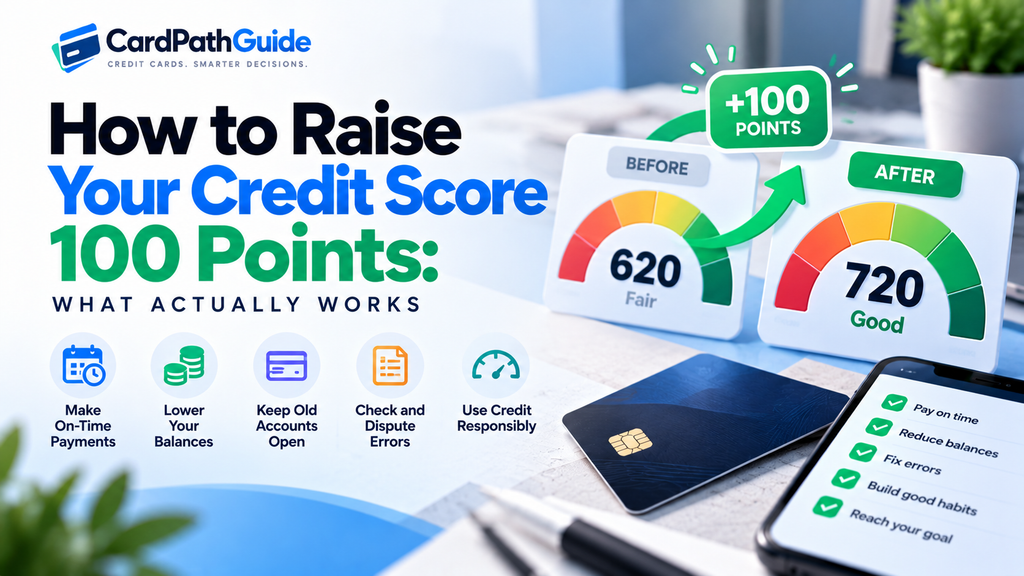
BHow to Raise Your Credit Score 100 Points? Raising your credit score by 100 points is possible for some people, but nobody can promise it. How much your score can change depends on what is pulling it down. The biggest and fastest gains usually come from correcting errors on your credit reports, bringing past-due accounts current and paying down credit card balances. Negative items such as late payments and collections fade slowly over time, and a score that is already high has much less room to grow.
This guide explains what actually moves your score, in the order that tends to matter most, and what does not work. It also tells you how long each step usually takes to show up, so you can set realistic expectations.
Last updated: October 2026.
Is a 100-point increase realistic?
It depends on where you start and why your score is low:
| Your situation | Room to improve | What usually drives the change |
|---|---|---|
| Very high credit card balances | Large | Paying balances down lowers your utilization, often within a billing cycle or two |
| Errors on your credit reports | Large, if the errors are serious | Removing wrong accounts, balances or late payments |
| A few recent late payments | Moderate | Staying current; the effect fades with time |
| Collections, charge-offs or bankruptcy | Moderate to large, over time | Time passing, plus the way your scoring model treats paid collections |
| Thin credit history | Moderate | Time and consistent on-time payments |
| Score already above 740 | Small | There is little left to fix |
That is why articles that promise «+100 points in 30 days» should make you cautious. Some people gain that much or more, usually after fixing a serious problem. Many others see smaller gains, which can still change the rates and products they qualify for.
Step 1: Find out what is holding your score down
Before you change anything, look at the evidence. Two things will tell you where to focus:
- Your credit reports. Get them for free at AnnualCreditReport.com. Look for late payments, collections, accounts that are not yours and balances that look wrong.
- The main factors behind your score. Many banks, card issuers and score services show the reasons that lower your score, such as «balances too high compared with credit limits» or «late payments». Those reasons point to your biggest opportunity.
Write down what you find and put the problems in order: errors first, then past-due accounts, then high balances, and then slower-moving issues.
Step 2: Dispute errors on your credit reports
Mistakes happen. Accounts that belong to someone else, wrong balances, payments reported as late when you paid on time and duplicate collections can all lower your score. Removing a serious error is one of the few ways to see a large improvement quickly.
To dispute an error:
- Contact the credit bureau that shows the error (Equifax, Experian or TransUnion) online or by mail. If the error appears on more than one report, dispute it with each bureau.
- Describe the item, explain why it is wrong and attach proof, such as a statement or a payment confirmation.
- Also tell the company that reported the information (the «furnisher»), because they are responsible for correcting it.
By law, the bureau generally has 30 days to investigate, and this can extend to 45 days in some cases. Keep copies of everything you send. If the bureau corrects the item, ask for an updated copy of your report. If it does not, you can add a short statement to your file and submit a complaint to the Consumer Financial Protection Bureau at consumerfinance.gov/complaint.
Only dispute information that is truly inaccurate. Disputing accurate, negative items rarely works and can waste your time.
Step 3: Bring past-due accounts current and never miss a payment again
Payment history is the largest part of your score. If you have an account that is behind, getting it current stops the damage from getting worse.
- Pay what is past due first, then keep the account current.
- Set up autopay for at least the minimum payment on every account, with a cushion in your bank account.
- Call your lender if you cannot pay. Many offer hardship plans, lower payments or a new due date, which can be better than missing a payment.
- Ask for a goodwill adjustment. If you have a good history with a lender and one late payment was an exception, you can ask in writing for them to remove it. They do not have to agree, but it costs nothing to ask.
Once an account is current, the older late payments stay on your report but matter less as time passes and as you add months of on-time payments.
Step 4: Lower your credit card utilization
If your cards are close to their limits, this is often the fastest lever you have, because utilization is based on the balances reported now and not on your history. When balances go down and the issuers report the new amounts, your score can respond within one or two billing cycles.
Here is an example with three cards:
| Scenario | Total balances | Total limits | Utilization |
|---|---|---|---|
| Before | $7,500 | $10,000 | 75% |
| After paying down $5,000 | $2,500 | $10,000 | 25% |
| After paying down $6,600 | $900 | $10,000 | 9% |
Ways to lower your utilization:
- Pay down balances, starting with the cards that have the highest utilization. Both the overall ratio and the ratio on each card matter.
- Pay before the statement closes. Issuers usually report your balance on your statement closing date. A payment made before that date means a lower balance is reported, even if you use the card all month.
- Make more than one payment per month if you spend a lot on one card.
- Ask for a credit limit increase. The same balance on a higher limit gives a lower ratio. Ask whether the issuer will do it with a soft inquiry, to avoid a hard one.
- Do not close cards you have paid off. Closing them reduces your available credit and can push your utilization up.
A common rule of thumb is to stay under 30% utilization, and lower is generally better. It is a guideline and not a fixed cutoff.
Step 5: Deal with collections the right way
A collection account can weigh down your score for years, but how you handle it matters. Before you pay anything:
- Confirm the debt is yours and the amount is right. Within 30 days of the first written notice from a collector, you can ask in writing for validation of the debt. Keep a copy of your request.
- Check the dates. A collection can generally appear on your reports for seven years from the date of the first missed payment with the original creditor. Paying it does not restart that clock on your credit report.
- Be careful with old debts. In some states, making a payment or acknowledging an old debt can affect your legal rights. If the debt is old, consider talking to a nonprofit credit counselor or an attorney before you pay.
- Get any agreement in writing before you pay, including how the account will be reported afterward.
What happens to your score when you pay a collection? It depends on the scoring model. Newer models, such as FICO Score 9 and 10 and VantageScore 3.0 and 4.0, ignore collections that have been paid. FICO Score 8, which is still widely used, and many older mortgage models still count a paid collection, although the account will show as paid. So paying a collection does not always raise the score at once, but it can matter for lenders who review your report manually and it stops the debt from growing.
«Pay for delete» agreements, in which a collector agrees to remove the account in exchange for payment, are never guaranteed, and some collectors do not accept them. If one agrees, get it in writing before you pay.
Medical debt has had special treatment from credit bureaus and under state laws, and the rules have changed in recent years. Check the current rules and ask the provider about financial assistance and payment plans before paying.
Step 6: Keep adding positive history
Once the main problems are fixed, the rest is about time and consistency:
- Keep your oldest accounts open and use them lightly, so the length of your history keeps growing.
- Apply for new credit only when you need it. Each hard inquiry can cause a small, temporary dip.
- Consider tools that add positive information, such as a credit-builder loan or a secured card if you have little history, or being added as an authorized user to a trusted person’s well-managed account. Check that the account reports to the bureaus.
- Review your reports every few months and again after you make changes, to confirm that updates were applied.
Also you can see this guide for building credit in 6 months
What does not work
Be careful with shortcuts that sound good but do not help, or that cost you money or time:
- Paying a company that promises to «erase» your bad credit. No one can remove accurate, negative information that is legally reportable. Companies that charge upfront fees before doing anything are a red flag, and the rules about this are strict.
- Closing old cards to «clean up» your report. This usually lowers your available credit and your average account age.
- Opening many new accounts to raise your limits. The inquiries and new accounts can lower your score first.
- Using a different identity number or a «new credit profile». This is illegal and can lead to serious consequences.
- Carrying a balance to «show activity». It only costs you interest. You can use a card lightly and pay the statement balance in full.
- Disputing accurate items again and again. Bureaus may dismiss repeated disputes that are not backed by new information.
How long each step takes to show up
| Action | When you might see an effect | Notes |
|---|---|---|
| Paying down credit card balances | One or two billing cycles | When the issuer reports the new balance |
| Correcting an error | Usually within 30 to 45 days of the dispute | If the bureau agrees it is an error |
| Bringing accounts current | Next reporting cycle for the account | Older late payments stay on the report |
| Credit limit increase | Next reporting cycle | Lowers utilization if your balance stays the same |
| Paying a collection | Depends on the scoring model | May not change the score in older models |
| Late payments aging | Gradually over months and years | They can remain on your reports for up to seven years |
| A hard inquiry | Fades over time | FICO counts inquiries from the last 12 months; they stay on the report for two years |
There is no set amount of time in which a score recovers. Most people see the best results when they combine several steps and keep up the habits for months.
Frequently asked questions
If your balances are high, paying them down is usually the fastest legitimate way, because utilization is recalculated each time your issuers report. If you have errors on your reports, correcting them can also produce a quick change.
Sometimes, if a serious problem such as very high utilization or a major error is fixed. But it is not typical, and nobody can guarantee it. Be skeptical of anyone who does.
It depends on what is causing the low score. Utilization and errors can change within weeks to a couple of months, while late payments and collections fade over years.
aying down or paying off a balance lowers your utilization, which usually helps. Keeping the account open afterward helps your available credit and your history.
Not necessarily. A paid collection is generally shown as paid, and it can stay on your report for up to seven years from the first missed payment. Newer scoring models ignore paid collections, while some older ones still count them.
No. Checking your own score or reports is a soft inquiry and does not affect your score.
You can dispute errors, ask for goodwill adjustments and negotiate with creditors yourself, for free. If you are considering paying for help, check the company carefully, read the contract, and remember that by law they cannot charge you before they perform the services. A nonprofit credit counselor can be a lower-cost starting point.
It can, by reducing your available credit and, over time, shortening your credit history.
Disclaimer
This article is for educational purposes only and is not financial, legal or credit advice. How much your score changes depends on your individual credit reports and on the scoring model used, and no outcome is guaranteed. Laws and credit bureau policies change. Check current information with the credit bureaus, the scoring companies or a qualified professional before making a decision.
Sources
- Consumer Financial Protection Bureau (consumerfinance.gov): disputing errors, credit reports and debt collection.
- Federal Trade Commission (consumer.ftc.gov): credit repair scams and your credit report rights.
- myFICO (myfico.com): how paid collections are treated in different FICO Score versions and the factors of a FICO Score.
- VantageScore (vantagescore.com): treatment of paid collections in VantageScore models.
- AnnualCreditReport.com: the official source for free credit reports.
Pingback: How Long it Takes to Build Credit? Timelines