
7 oct 2026 · @Marc Cirio
To build credit from scratch, open one account that reports to the credit bureaus, such as a secured credit card or a credit-builder loan, use it for small purchases, and pay it on time every month. With on-time payments and low balances, you can expect to have your first credit score in about six months and to keep improving it from there.
It sounds like a catch-22: lenders want to see a credit history before they approve you, and you need credit to have a history. The good news is that there are products designed exactly for this situation. This guide shows you which options to consider, gives you a month-by-month plan for the first six months, and explains the mistakes that slow people down.
Last updated: October 2026.
Why it is hard to get started
If you have never had a credit account, you probably have a «thin file» or no file at all with the credit bureaus (Equifax, Experian and TransUnion). Without information, scoring models cannot calculate a score. To generate a FICO Score, you generally need at least one account that has been open for at least six months and has reported to the bureaus within the last six months. VantageScore models can generate a score with less history, sometimes after a single account has been reported for about a month.
That is why the first step is simple: get one account that reports your payments, and give it time. You do not need many accounts, a large income or debt. You need a record of paying on time.
Before you start: check your credit reports
Even if you think you have no credit, check first. Get your free reports from AnnualCreditReport.com, the official source. Look for accounts you do not recognize, which could be a sign of identity theft, and confirm that you really have no file. If you find an error, you can dispute it with the bureau that issued the report.
It is also a good moment to gather what lenders usually ask for in an application: a government-issued ID, your Social Security number or ITIN, your address and details about your income.
Your options for starting credit
There is no single best product for everyone. The right choice depends on whether you can afford a deposit, whether you are a student and whether someone you trust can help. Here are the four most common ways to start.
| Option | How it works | Typical cost | Watch out for |
|---|---|---|---|
| Secured credit card | You put down a refundable security deposit, often $200 or more, and that amount usually becomes your credit limit. You use the card like any other. | Deposit (refundable) and, on some cards, an annual fee | Choose a card that reports to all three bureaus and has no annual fee, if possible |
| Credit-builder loan | The lender holds the loan amount in a locked account while you make monthly payments. You receive the money at the end. | Interest and sometimes fees | The money is not available until the loan ends; make sure the lender reports to the bureaus |
| Authorized user | A family member or trusted person adds you to their credit card. The account history can appear on your report. | Usually none | Their habits affect you. Some lenders and scoring models give it less weight, and a late payment on the card can hurt you |
| Student credit card | An unsecured card designed for students with little or no history. | Some have no annual fee | Limits are low, and interest rates can be high, so pay in full |
How to choose
- Can you put down a deposit? A secured card is often the simplest and most predictable choice.
- Do you prefer not to have a card? A credit-builder loan builds a history of on-time installment payments, and the monthly payment works like a forced savings plan.
- Is someone in your family willing to help? Becoming an authorized user on a card with a long history of on-time payments and low balances can give you a head start, but only if you trust the account holder.
- Are you a college student? Compare the student cards available to you, and read the fees and interest rate carefully.
What to check before you apply
These details matter more than rewards or a name you recognize:
- Does it report to all three bureaus (Equifax, Experian and TransUnion)? If it does not, it will not build your credit.
- What are the fees? Look for annual, monthly and setup fees, and avoid cards with high fees relative to the credit line.
- Is the deposit refundable? Your deposit should be returned when you close the account in good standing or move to an unsecured card.
- Is there a path to upgrade? Some issuers review your account after a period of on-time payments and may convert it to an unsecured card and return your deposit.
- Does the issuer offer a pre-qualification check? Many do, with a soft inquiry that does not affect your score, which tells you whether you are likely to be approved before a hard inquiry is made.
Apply for one product at a time. Several applications in a short time create several hard inquiries and look risky to lenders.
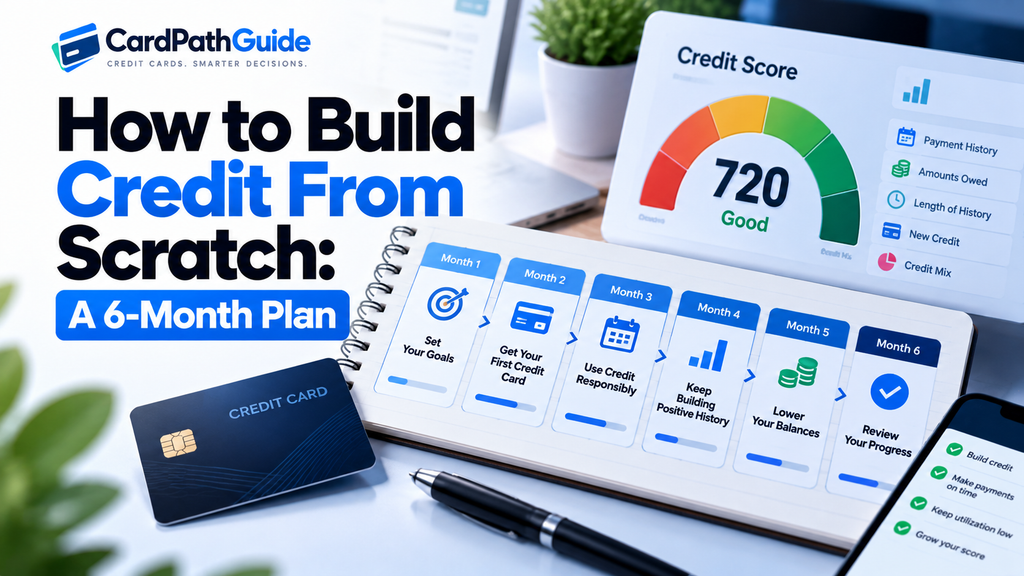
Your 6-month plan to build credit
This plan assumes you start with one secured card, but the same schedule works for a credit-builder loan or a student card. The goal is not speed. It is to create a clean, consistent record.
| When | What to do | Goal |
|---|---|---|
| Before month 1 | Check your credit reports at AnnualCreditReport.com, choose one product, check pre-qualification if offered, and apply | Start with one account and no surprises on your file |
| Month 1 | Activate the account. Set up autopay for the full statement balance (or at least the minimum). Put one small recurring bill on the card, such as a subscription you already pay | Start the habit of using the account and paying on time |
| Month 2 | Receive your first statement. Pay the full balance before the due date. Confirm in your bank or card app that the account reports to the bureaus | Your first reported payment |
| Month 3 | Review your balance against your limit. Check your free reports to confirm the account appears. Do not apply for other credit | Utilization under about 30%, and ideally lower |
| Month 4 | Keep the same routine. Do not increase your spending just because the card is available | Four on-time payments in a row |
| Month 5 | Read the issuer’s terms about upgrades and deposit refunds. Check your reports again for errors | Know your next step |
| Month 6 | Look up your first score. Decide if you want to keep going as is, ask about an upgrade or add a second product | A first score and a plan |
What a month of good use looks like
Suppose your secured card has a $200 limit. You put your $15 streaming subscription on it each month, and you pay the statement balance in full before the due date. Your utilization is about 7.5%, you pay no interest, and every month the issuer reports an on-time payment. That is all it takes to build a solid foundation.
How to make the most of each month
- Use the card, but lightly. An account that is never used may be closed by the issuer. A small, regular purchase keeps it active.
- Pay the statement balance in full. You build credit by paying on time, not by paying interest. Carrying a balance does not help your score.
- Keep the reported balance low. Issuers usually report your balance on your statement closing date. If you spend more during the month, you can pay part of the balance before the statement closes, so a lower balance is reported.
- Put payments on autopay, and keep a small cushion in the bank account that covers them.
- Check your progress through the free score tools offered by your bank or card issuer, and compare month to month instead of day to day.
Mistakes that slow down your progress
Building credit is mostly about avoiding a few common errors.
- Missing a payment. A payment reported 30 days or more late can stay on your reports for up to seven years. Autopay is your best protection.
- Using too much of your limit. Maxing out a card sends a bad signal even if you pay it off later. Keep your balance low.
- Carrying a balance «to build credit.» This is a myth. You do not need to pay interest to build credit. Paying the statement balance in full works just as well and costs nothing.
- Applying for several cards at once. Each application can create a hard inquiry, and several in a short time can lower your score and make lenders cautious.
- Closing the card too early. It is better to keep your first account open and in good standing, as the length of your history is part of your score.
- Assuming debit cards help. Debit cards and bank accounts are not reported to the credit bureaus, so they do not build credit.
- Paying for «guaranteed» credit services. No company can promise to create a good credit history for you. Be careful with anyone who asks you to pay large upfront fees or who offers a new «credit profile number» (CPN). These offers are often scams, and using a fake number to apply for credit is illegal.
- Choosing a high-fee product. Compare annual, monthly and setup fees before you apply. A card or loan that costs more than its benefits will slow you down.
What comes after six months
After about six months of on-time payments and low balances, you will probably have your first score and be in a better position. Common next steps:
- Keep your first account open and keep using it lightly. Time and consistency now work in your favor.
- Ask about an upgrade. Some issuers review secured accounts after several months and can convert them to an unsecured card and refund your deposit.
- Consider a second product after at least six months, such as a no-annual-fee card with basic rewards, if your score and income support it.
- Raise your credit limit over time, through an increase offered by the issuer. A higher limit with the same spending lowers your utilization.
- Keep checking your reports at least once a year for errors.
Your score will probably not be in the «excellent» range after six months. Reaching a good score generally takes longer, and the steps are the same: pay on time, keep balances low and let your history age.
Frequently asked questions
You can usually get a first FICO Score after about six months of an account reporting. Reaching a good score generally takes longer, often a year or more, depending on your payments, balances and history.
Opening one account that reports to all three bureaus, such as a secured card or a credit-builder loan, and paying it on time every month. There are no shortcuts beyond that, and anyone who promises one is probably selling something.
Yes. A credit-builder loan, becoming an authorized user on someone else’s account, or services that report certain payments such as rent can help. Check that the payments are reported to the credit bureaus.
Yes, as long as the issuer reports your account to the credit bureaus. Your payments and balances are reported the same way as on any other card.
Generally yes, when you close the account in good standing or when the issuer upgrades it to an unsecured card. Confirm the terms before you apply.
There is no standard starting score. It depends on how you use the account, mainly your payment history and your utilization.
Only if your landlord or a rent-reporting service sends the payments to the credit bureaus. Rent payments are not normally part of your credit report on their own.
One. After about six months of on-time payments, you can consider adding another one.
Most lenders ask for a Social Security number or an Individual Taxpayer Identification Number (ITIN). Requirements vary by lender, so check before you apply.
Disclaimer
This article is for educational purposes only and is not financial, legal or credit advice. Products, fees, interest rates and eligibility requirements change and vary by provider. Check the current terms with the provider before you apply, and consider your own circumstances.
Sources
- Consumer Financial Protection Bureau (consumerfinance.gov): credit reports, credit scores and building credit.
- myFICO (myfico.com): requirements to generate a FICO Score and the factors of a score.
- VantageScore (vantagescore.com): score requirements and model information.
- AnnualCreditReport.com: the official source for free credit reports.