
7 oct 2026 · @Marc Cirio
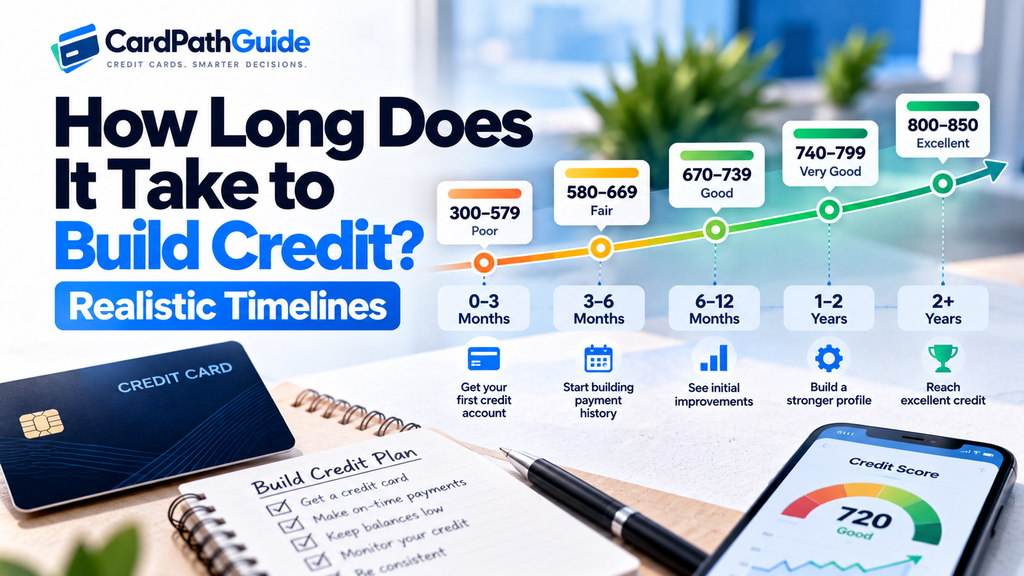
How long it takes to build credit? You can usually get your first credit score after about six months of having an account that reports to the credit bureaus. Reaching a good score generally takes longer, often one to two years of on-time payments and low balances, although the exact time depends on your starting point. Rebuilding after serious problems, such as collections or a bankruptcy, can take several years.
There is no universal timeline, because credit is not built with a calendar but with a record. Each month you pay on time adds to that record. In this guide you will see what to expect at each stage, how long it takes in different situations, how long negative items stay on your reports and what you can do to move faster.
Last updated: October 2026.
A general timeline for building credit
This is a typical path for someone who starts with no credit history, opens one account and uses it responsibly. Your own results may be faster or slower.
| When | What usually happens |
|---|---|
| Month 1 | Your account is open and starts to report. There may be no score yet, because scoring models need some history |
| Months 2 to 3 | Your first payments are reported. You are building a payment record, but a FICO Score may still not be available |
| Month 6 | You can generally get a first FICO Score. VantageScore models may produce a score earlier |
| Months 12 to 18 | With on-time payments and low balances, a score in the fair to good range becomes realistic for many people |
| Months 24 and beyond | Your account age grows, and you may qualify for better products. A very good score generally takes longer |
| Years 3 to 7 | Older negative marks, if any, lose weight. A long history of on-time payments is a strong asset |
These figures are general guidelines, not promises. Someone with no negative marks and low balances may move faster, and someone who misses payments or carries high balances will move slower.
Why six months?
FICO Scores generally require at least one account that has been open for six months and that has reported to the credit bureaus in the last six months. That is why many people see no FICO Score at first, even if they have been paying on time. Other models, such as VantageScore, can generate a score with less history, so you might see a score from a free service sooner. Both are valid, and they may differ.
How long it takes in different situations
The fastest way to know what to expect is to look at where you start. These are general ranges and not guarantees.
| Your starting point | Typical time to see meaningful progress | What to focus on |
|---|---|---|
| No credit history | First score after about 6 months; a good score often takes 1 to 2 years | One reporting account, on-time payments and low balances |
| Thin file (one or two accounts) | Several months to a year | Keep accounts open, add a second account when ready |
| High credit card balances | One or two billing cycles after the issuer reports the lower balance | Pay down balances to lower utilization |
| Errors on your reports | About 30 to 45 days after a dispute | Dispute inaccurate items with the bureau and the lender |
| A few recent late payments | The effect fades gradually over one to two years of clean payments | Never miss a payment; set up autopay |
| Collections or charge-offs | Often one to three years for a meaningful recovery | Handle the debt properly and keep all other accounts current |
| Bankruptcy | Typically several years to rebuild | A secured card or credit-builder loan and perfect payment habits |
| Foreclosure or repossession | Several years | Same habits, plus patience |
In every case the same pattern repeats: recent behavior counts more than old behavior. A score can recover even when your report still shows past problems, because every new month of on-time payments pushes older mistakes further into the past.
What affects how fast your credit grows
- Payment history. Missing a payment can set you back months or years. Paying on time is the engine of progress.
- Credit utilization. Low balances relative to your limits help your score quickly, since this factor changes as soon as your issuers report new balances.
- Age of your accounts. This is the one factor you cannot speed up. Keeping your oldest accounts open helps your history grow.
- New accounts. Opening several accounts in a short time can lower your average account age and create hard inquiries, which slows you down in the short term.
- The type of negative items on your reports. Late payments, collections and bankruptcies each weigh differently, and all of them fade with time.
How long negative items stay on your credit report
Negative information does not stay forever. Under federal law and credit bureau practices, most items have a maximum reporting period:
| Item | How long it generally stays on your report |
|---|---|
| Late payments | Up to 7 years from the date of the missed payment |
| Collection accounts | Up to 7 years from the date of the first missed payment with the original creditor |
| Charge-offs | Up to 7 years |
| Foreclosure | Up to 7 years |
| Chapter 13 bankruptcy | Up to 7 years from the filing date |
| Chapter 7 bankruptcy | Up to 10 years from the filing date |
| Hard inquiries | 2 years (FICO Scores only count those from the last 12 months) |
| Closed accounts in good standing | Generally up to 10 years |
The impact of these items is largest at first and shrinks over time, long before they disappear from your reports. A late payment from five years ago weighs much less than one from five months ago, especially if everything since then has been on time.
How to build credit faster
You cannot make time pass faster, but you can avoid wasting it:
- Start now. The earlier your first account reports, the earlier your history starts to grow. You do not need to wait until you «need» credit.
- Pay every bill on time. Set up autopay so a forgotten date never costs you months of progress.
- Keep balances low. Aim to use a small part of your limits, ideally well under 30%.
- Keep your oldest accounts open. They give your history length.
- Apply for new credit slowly. One new account at a time, only when you need it.
- Fix errors early. Check your reports at AnnualCreditReport.com and dispute anything inaccurate.
- Add positive history if you have little. A secured card, a credit-builder loan or becoming an authorized user on a well-managed account can help.
For step-by-step plans, see how to build credit from scratch and how to raise your credit score. In practice, the biggest difference is made by consistency: a steady, boring routine beats any trick.
Frequently asked questions
You can generally get a first FICO Score after about six months of an account reporting. A good score often takes one to two years of on-time payments and low balances, although the time varies from person to person.
It depends on where you start. For someone with no negative marks, reaching about 700 within one to two years is a reasonable expectation, but not a guarantee. If you have late payments or collections, it can take longer.
You can start building it, but you will probably not have a full FICO Score yet. Some free services may show a VantageScore earlier. A few months of payments is a start, not a finished record.
Many people begin to see improvement within a year or two of consistent on-time payments, but rebuilding fully often takes several years. The bankruptcy itself can stay on your report for up to 7 or 10 years, depending on the type, and its effect lessens as time passes.
The effect of paying down balances can show up within one or two billing cycles, once your card issuer reports the new balance to the credit bureaus.
Your score can change whenever new information is reported to the bureaus, which can be monthly or more often, depending on the lender.
It can. Closing an account reduces your available credit and may shorten your credit history over time. Accounts in good standing generally stay on your report for years after they close.
Disclaimer
This article is for educational purposes only and is not financial, legal or credit advice. Timelines are general estimates. How long it takes to build or rebuild credit depends on your individual reports, the scoring model and the lenders you use, and no result is guaranteed. Laws and credit bureau policies change. Check current information with the credit bureaus or a qualified professional before making a decision.
Sources
- myFICO (myfico.com): requirements to generate a FICO Score and the factors of a score.
- VantageScore (vantagescore.com): score requirements and model information.
- Consumer Financial Protection Bureau (consumerfinance.gov): how long negative information stays on your credit reports and how to dispute errors.
- AnnualCreditReport.com: the official source for free credit reports.
Pingback: How to Build Credit From Scratch: A 6-Month Plan