
7 oct 2026 · @Marc Cirio
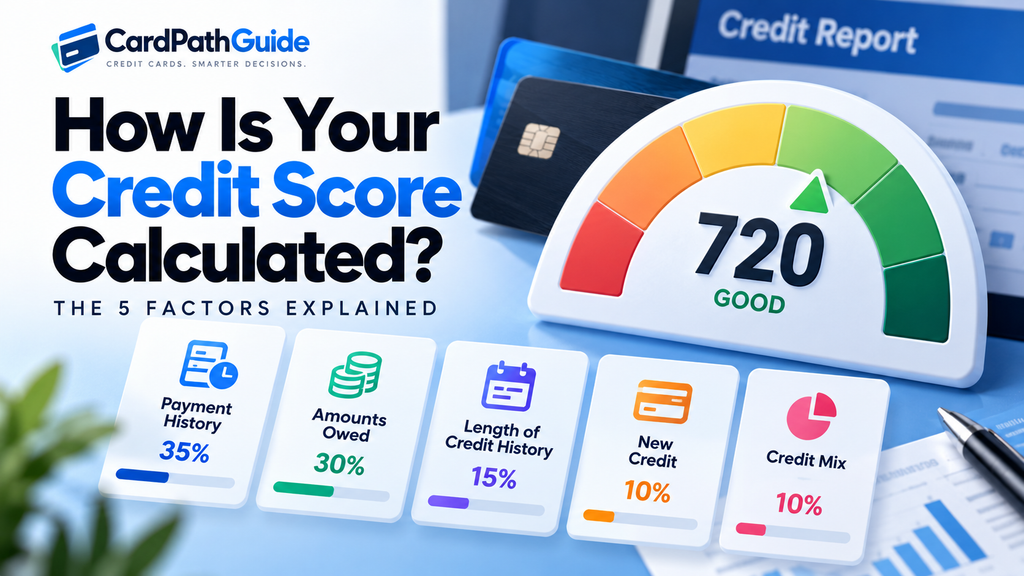
How Is Your Credit Score Calculated? Your credit score is calculated from the information in your credit reports, and for FICO Scores, the most widely used model, it comes down to five factors: payment history (35%), amounts owed (30%), length of credit history (15%), new credit (10%) and credit mix (10%). Paying on time and keeping your balances low account for about two thirds of the score, so those are the two things that matter most.
The exact formulas are private, so nobody can tell you precisely how many points a single action is worth. But the factors and their approximate weights are public, and understanding them is enough to know where to focus. This guide explains each factor in plain English, what is not part of your score, and how to put this knowledge to use.
Not sure what counts as a good score? See what a good credit score is.
Last updated: October 2026.
The five factors at a glance
| Factor | FICO weight | What it measures | What helps |
|---|---|---|---|
| Payment history | 35% | Whether you pay your accounts on time | Never missing a due date |
| Amounts owed | 30% | How much debt you carry, especially compared with your credit limits | Keeping balances low |
| Length of credit history | 15% | How long your accounts have been open | Keeping old accounts open |
| New credit | 10% | How many accounts you have opened or applied for recently | Applying only when you need to |
| Credit mix | 10% | The variety of credit types you manage | Managing the accounts you have well |
The percentages are an average for the general population. For your own report the importance of each factor can differ. For example, if you have very little history, the length of your credit history carries less information, and a missed payment can weigh heavily.
1. Payment history (35%)
Payment history is the biggest factor, and the question it answers is simple: do you pay what you owe on time? Lenders care about this more than anything else, because the best predictor of future payments is past payments.
This factor looks at:
- whether you paid your credit cards, loans and other accounts on time;
- how late any late payments were (30, 60, 90 or more days);
- how recent they were and how many there are;
- serious negative events such as collections, charge-offs, foreclosures and bankruptcies.
A payment is generally reported as late once it is 30 days or more past due. Paying a few days after the due date may bring a late fee from your lender, but it is normally not reported to the credit bureaus. Once a late payment is reported, it can stay on your credit reports for up to seven years, although its impact fades as it gets older. A bankruptcy can stay on your reports for up to seven or ten years, depending on the type.
What to do: set up automatic payments for at least the minimum amount on every account, so a forgotten due date never turns into a mark on your report.
2. Amounts owed (30%)
The second-largest factor looks at how much debt you carry. The most important piece is your credit utilization ratio: the percentage of your available revolving credit that you are using.
To calculate it, divide your balance by your credit limit:
| Card | Balance | Credit limit | Utilization |
|---|---|---|---|
| Card A | $1,500 | $5,000 | 30% |
| Card B | $200 | $1,000 | 20% |
| Total | $1,700 | $6,000 | 28% |
Scoring models look at your utilization on each card and across all your cards together. A common rule of thumb is to stay below 30%, and people with the highest scores usually use far less. A lower ratio generally helps, and a ratio close to or above 100% can hurt your score a lot.
Other things this factor considers include:
- the total amount you owe across all accounts;
- how much you still owe on installment loans compared with the original amount;
- the number of accounts that carry a balance.
Good to know: card issuers usually report your balance to the credit bureaus once a month, often on your statement closing date. That means you can have a low utilization on your report even if you use the card regularly, as long as you pay down the balance before the statement closes.
What to do: pay down balances, spread spending across cards if that helps keep each ratio low, and ask for a credit limit increase if you can get one without a hard inquiry. A higher limit with the same balance lowers your utilization. Do not close cards just to simplify, because that reduces your total available credit.
3. Length of credit history (15%)
This factor rewards experience: the longer you have managed credit responsibly, the more information scoring models have about you. They look at:
- the age of your oldest account;
- the age of your newest account;
- the average age of all your accounts;
- how long it has been since you used certain accounts.
You cannot speed up time, but you can avoid shortening it. Opening several new accounts lowers the average age of your accounts, and closing an old account can eventually reduce the length of your history, because closed accounts in good standing stay on your reports for years but may drop off later.
What to do: keep your oldest cards open, especially those with no annual fee, and use them for a small purchase now and then so the issuer does not close them for inactivity. If you are just starting, the best strategy is simply to open one account and keep it in good standing.
4. New credit (10%)
When you apply for credit, the lender usually checks your credit report. This creates a hard inquiry, which can lower your score by a few points for a short time. Opening several accounts in a short period can look risky to lenders, because it may signal that someone is in financial trouble.
This factor considers:
- how many accounts you have opened recently;
- how many hard inquiries you have;
- how long it has been since you opened an account or applied for credit.
Hard inquiries stay on your credit report for two years, but FICO Scores only count those from the last 12 months. Checking your own score or credit report is a soft inquiry and never affects your score. Soft inquiries also include pre-qualification checks and offers from lenders.
Rate shopping is treated differently. If you shop around for a mortgage, auto loan or student loan, scoring models generally count multiple inquiries made within a short window as a single one. The window is typically between 14 and 45 days, depending on the scoring model. This does not apply to credit cards: each credit card application is counted separately.
What to do: apply only for credit you actually need, and avoid applying for several cards at once.
5. Credit mix (10%)
Credit mix looks at the variety of accounts on your reports, such as:
- revolving accounts, like credit cards, where you can borrow and repay repeatedly;
- installment loans, like auto loans, student loans, mortgages and personal loans, where you repay a fixed amount over a set period.
Having experience with both types shows that you can manage different kinds of credit. But this is the smallest factor, and you do not need to take out a loan just to improve your mix. Paying interest on debt you do not need costs far more than the small score benefit is worth.
If you have only credit cards, or only loans, you can still have an excellent score as long as you pay on time and keep balances low.
What to do: do not worry about mix. Manage the accounts you have well, and add a new type only when you have a real reason to.
What is not part of your credit score
Many people believe that things like income or savings affect their score. They do not. These are not included in FICO Scores:
- your income, salary or employment history;
- your race, color, religion, national origin, sex or marital status;
- your age;
- where you live;
- the balance of your checking and savings accounts;
- whether you checked your own credit (a soft inquiry);
- debit card use, which is not reported as credit.
Rent and utility payments are generally not part of your credit report unless a service reports them or the account goes to collections. Lenders can still ask for your income and other information when you apply, but that is part of their decision and not of your score.
How VantageScore weighs the same information
VantageScore, the second major scoring family, uses the same kinds of information from your credit reports but groups and weighs them a little differently. In its current version, VantageScore 4.0, the most influential factor is payment history, followed by the depth of your credit history (age and mix of accounts) and your credit utilization. Total balances, recent credit activity and available credit are less influential.
The result is the same in practice: pay on time, keep balances low and avoid unnecessary new accounts. To see how the two models differ, and why your scores may not match, read our comparison of FICO and VantageScore.
Where to focus first
If you want to improve your score, put your effort in this order, which follows the weight of each factor:
- Pay every bill on time. One missed payment can undo months of progress.
- Lower your credit card balances. Reducing utilization is often the fastest way to see a change.
- Keep your old accounts open. Avoid closing your oldest card.
- Apply for new credit sparingly. Wait until you really need it.
- Do not chase credit mix. It is the least important factor.
Why your score can change from month to month
Your score is recalculated every time a lender or a scoring service asks for it, using the latest data in your credit report. It can move when a card issuer reports a new balance, when a payment posts, when a new account appears or when an old account closes or ages. Small moves of a few points are normal and are not a sign that something is wrong. What matters is the long-term direction.
If your score drops suddenly by a lot, check your credit reports for errors or accounts you do not recognize. You can get your free reports from AnnualCreditReport.com.
Frequently asked questions
Payment history (35%), amounts owed (30%), length of credit history (15%), new credit (10%) and credit mix (10%). These are the weights FICO publishes for its standard scores.
Payment history. Paying on time is the single most important habit, followed closely by keeping your balances low.
No. Checking your own score or report is a soft inquiry and does not affect your score. Hard inquiries happen when you apply for credit.
aying down a balance lowers your credit utilization, which usually helps. Paying your statement balance in full each month also avoids interest. You do not need to carry a balance to build credit.
There is no fixed number. The effect depends on your overall profile: people with higher scores tend to lose more points from a single late payment than people who already have negative marks. It is more useful to focus on never missing a payment.
It can. Closing a card reduces your total available credit, which can raise your utilization ratio, and over time it can shorten your credit history.
Changes in balances can show up within one or two billing cycles, once your issuer reports the new balance. Late payments, collections and other negative items fade slowly over years.
Many banks, card issuers and score services show the main factors behind your score. If a lender denies your application or offers you worse terms because of your credit, it must send you a notice with the main reasons and the score it used.
Disclaimer
Disclaimer
This article is for educational purposes only and is not financial, legal or credit advice. Scoring models are proprietary and change over time, and the weights shown are general guidelines that FICO publishes for its standard scores. Your results may differ. Check current information with the scoring company or lender before making a decision.
Sources
- myFICO (myfico.com): the five FICO Score factors and their weights.
- VantageScore (vantagescore.com): VantageScore 4.0 factor information.
- Consumer Financial Protection Bureau (consumerfinance.gov): credit reports, inquiries and your rights.
- AnnualCreditReport.com: the official source for free credit reports.