(FICO and VantageScore)
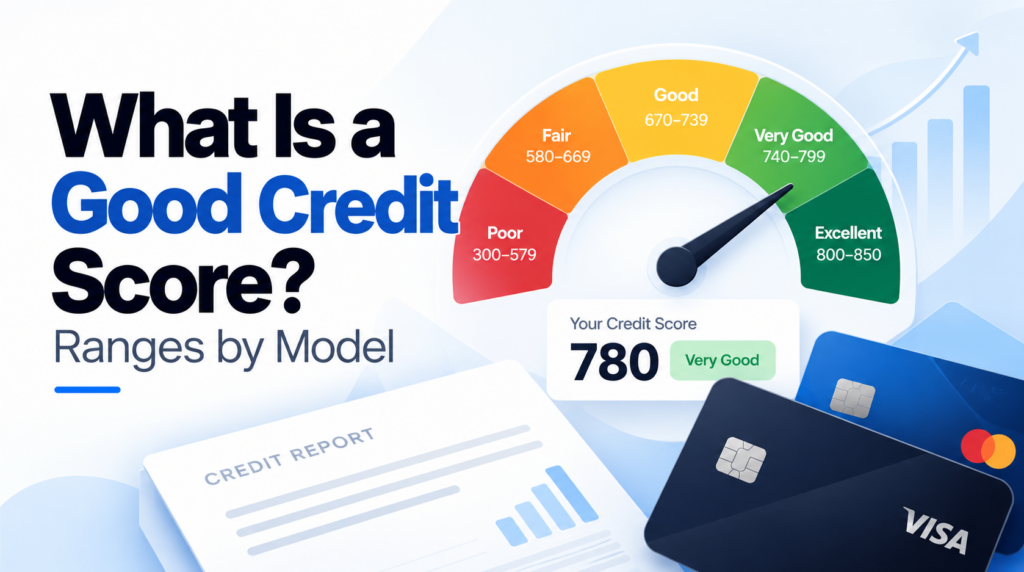
A good credit score is generally 670 or higher on the FICO scale, which runs from 300 to 850. On the VantageScore scale, which uses the same 300–850 range, a good score starts at 661. Scores of 740 and above are usually considered very good or excellent, and they tend to unlock the lowest interest rates and the widest choice of credit cards and loans.
But «good» is not a single number. The score you need depends on what you are applying for, on the scoring model the lender uses, and on the rest of your credit report. In this guide you will find the official score ranges, what each range usually means in practice, and how to find out where you stand.
Last updated: October 2026.
Credit score ranges at a glance
There are two main scoring families in the United States: FICO and VantageScore. Both use a 300–850 scale, but they label the ranges differently.
FICO score ranges
| FICO score | Rating | What it usually means |
|---|---|---|
| 800–850 | Exceptional | Access to the best rates and terms; very few denials |
| 740–799 | Very good | Well above average; approved for most products at favorable rates |
| 670–739 | Good | Near or slightly above the national average; approved by most lenders |
| 580–669 | Fair | Below average; more denials and higher rates, but options exist |
| 300–579 | Poor | Hard to get approved for unsecured credit; usually higher deposits or fees |
VantageScore 3.0 and 4.0 ranges
| VantageScore | Rating | What it usually means |
|---|---|---|
| 781–850 | Excellent | Best rates and terms |
| 661–780 | Good | Approved by most lenders at competitive rates |
| 601–660 | Fair | More limited options and higher costs |
| 500–600 | Poor | Difficult to qualify for unsecured credit |
| 300–499 | Very poor | Very limited options |
These labels are guidelines, not rules. Every lender sets its own cutoffs, and two lenders can treat the same score differently.
What is the average credit score in the U.S.?
The average FICO score in the United States has been in the low 700s in recent years, with FICO reporting an average of 715 in 2025. That means a score around 715 is close to the middle of the pack, and it sits in the «good» range of both models. Averages move slowly from year to year, so the exact figure matters less than the range you fall into.
Is 670 really the cutoff for «good»?
On the FICO scale, yes: 670 is where the «good» band begins. But it is helpful to think of scores in steps rather than as a pass or fail line:
- Below 580: you will likely need a secured card or a credit-builder product, and some applications will be denied.
- 580–669: you can qualify for some products, usually with higher interest rates and fees.
- 670–739: you can qualify for most mainstream products.
- 740 and above: you are generally offered the best advertised rates, and further increases rarely change the terms much.
The jump from fair to good is the one that changes the most: it is where more lenders start to say yes.
What credit score do you need for different goals?
A score that is «good» for one goal can fall short for another. The table below shows the benchmarks lenders commonly use. They are general guidelines and not guarantees: each lender sets its own rules, and a score is only one part of an application.
| Goal | Score lenders commonly look for | What to know |
|---|---|---|
| Secured credit card | No minimum, or fair-to-poor credit accepted | Requires a refundable deposit; a way to start or rebuild |
| Standard unsecured credit card | Often 600–670 and above | Rewards and premium cards typically look for good to excellent credit (about 700+) |
| Renting an apartment | Many landlords look for about 600–650 and above | Landlords also check income and rental history; a lower score may mean a larger deposit |
| Auto loan | Rates improve in tiers (commonly 661+ is «prime») | Even a modest score increase can lower the interest rate over the loan |
| Personal loan | Some lenders approve from about 580–600 | The lowest rates usually require about 700 or higher |
| Conventional mortgage | Commonly a minimum of 620 | A higher score lowers the rate and the cost of mortgage insurance |
| FHA mortgage | 580 for a 3.5% down payment; 500–579 may require 10% down | Lenders can set stricter minimums than the program |
For the mortgage figures in particular, rules and scoring models are changing, so check the current requirements with a lender before making plans. Our guide on [what credit score you need for a mortgage] goes deeper into this.
A good score is not the only thing lenders look at
Your score is a summary, not the whole picture. When you apply for credit, lenders may also look at:
- Your income and whether it is stable.
- Your debt-to-income ratio: how much of your monthly income already goes to debt payments.
- Your full credit report: recent late payments, collections or bankruptcies can matter more than the number.
- Your relationship with the lender: an existing bank account or loan can sometimes help.
This is why two people with the same score can get different answers. It also means that a score in the «good» range does not guarantee approval, and a score in the «fair» range does not always mean denial.
What makes up your credit score?
FICO scores are built from five categories. The weights below are the ones FICO publishes for its standard scores:
| Factor | Weight | In simple terms |
|---|---|---|
| Payment history | 35% | Do you pay on time? |
| Amounts owed | 30% | How much of your available credit you use (credit utilization) |
| Length of credit history | 15% | How long your accounts have been open |
| New credit | 10% | How many accounts you have opened or applied for recently |
| Credit mix | 10% | The variety of accounts you manage (cards, loans) |
Paying on time and keeping your balances low account for about two thirds of the score, so those two habits are where most people see the biggest changes.
Why your scores may differ from site to site
You do not have just one credit score. You have many, and they can differ by dozens of points. The main reasons:
- Different scoring models. FICO and VantageScore each publish several versions, and lenders use different ones depending on the product. Auto lenders and card issuers often use industry-specific versions.
- Different credit bureaus. Equifax, Experian and TransUnion each keep their own file on you. A lender may report to one, two or all three, so each file can contain slightly different information.
- Different timing. Scores change whenever your balances or accounts are updated, which can be daily or monthly.
A 20–40 point difference between two sources is not unusual and does not mean something is wrong. What matters is the range you are in and the direction your score is moving. If you want to understand this in more depth, read [FICO vs VantageScore: What Is the Difference?].
How to check your credit score for free
Checking your own score is a «soft inquiry» and does not lower it. These are the most common free options:
- Your bank or credit card issuer. Many include a free FICO or VantageScore in your online account or app.
- Free credit-score services. Some show a VantageScore based on data from one or two bureaus. Compare the model and the bureau before treating the number as exact.
- Your credit reports at AnnualCreditReport.com. This is the official source for free reports from all three bureaus. Reports do not include a score, but they show the accounts and information that the score is built from, and you can use them to check for errors.
We list the safest options step by step in [How to Check Your Credit Score for Free].
How to move from fair to good (and from good to very good)
There are no shortcuts, but a few habits account for most of the improvement:
- Pay every bill on time. Payment history is the biggest factor. Set up automatic payments for at least the minimum so that you never miss a due date.
- Keep your credit utilization low. A common rule of thumb is to stay under 30% of your credit limit on each card, and lower is generally better. You can reduce it by paying down balances or by asking for a credit limit increase.
- Keep older accounts open. Closing an old card can shorten your average credit history and reduce your available credit.
- Apply for new credit only when you need it. Each application can cause a small, temporary dip.
- Check your credit reports for errors. Wrong balances, accounts that are not yours or incorrect late payments can hurt your score. You have the right to dispute them with the bureau.
- If you have little or no history, a secured credit card or a credit-builder loan reports on-time payments and can help you start.
Improvement takes time. Late payments and collections generally stay on your reports for up to seven years, and their effect fades as they age. For a step-by-step approach, see [How to Raise Your Credit Score 100 Points: What Actually Works].
Bottom line
A score of 670 or higher on FICO (661 or higher on VantageScore) is generally considered good, and 740 or higher is considered very good. Use those ranges as a map, not as a verdict: the number you need depends on your goal, and the habits that move your score, paying on time and keeping balances low, are the same at every level.
Frequently asked questions
Yes. A 700 falls in the «good» range on both FICO (670–739) and VantageScore (661–780). It is above the national average and qualifies for most mainstream credit products.
On the FICO scale, 750 is «very good» (740–799). On VantageScore, it is «good» (661–780), since «excellent» starts at 781. Either way, it is a strong score.
No. Scores of 800 and above are rated exceptional by FICO, and the benefits flatten out at the top. Getting from 780 to 850 rarely changes the terms you are offered
On FICO, a score below 580 is «poor.» On VantageScore, scores below 601 are «poor» or «very poor.» A lower score does not mean you cannot get credit, but it usually means higher costs and fewer options.
The lowest is 300 and the highest is 850 on both FICO and VantageScore.
No. Checking your own score is a soft inquiry and does not affect it. Hard inquiries happen when you apply for credit.
It depends on what is holding it back. Lowering high balances can show up within a billing cycle or two, while late payments and collections fade slowly over years. Consistent habits matter more than any single move.
A score generally needs at least one account that has been open and reporting for several months. A secured credit card or a credit-builder loan can start your history. See [How to Build Credit From Scratch].
Disclaimer
This article is for educational purposes only and is not financial, legal or credit advice. Score ranges and lender requirements vary and can change. Check the current terms with the lender or the scoring company before making a decision.
Sources
- myFICO (myfico.com): FICO score ranges and the factors that make up a FICO score.
- VantageScore (vantagescore.com): VantageScore ranges and model information.
- Consumer Financial Protection Bureau (consumerfinance.gov): credit reports, scores and your rights to dispute errors.
- AnnualCreditReport.com: the official source for free credit reports.
Deja una respuesta